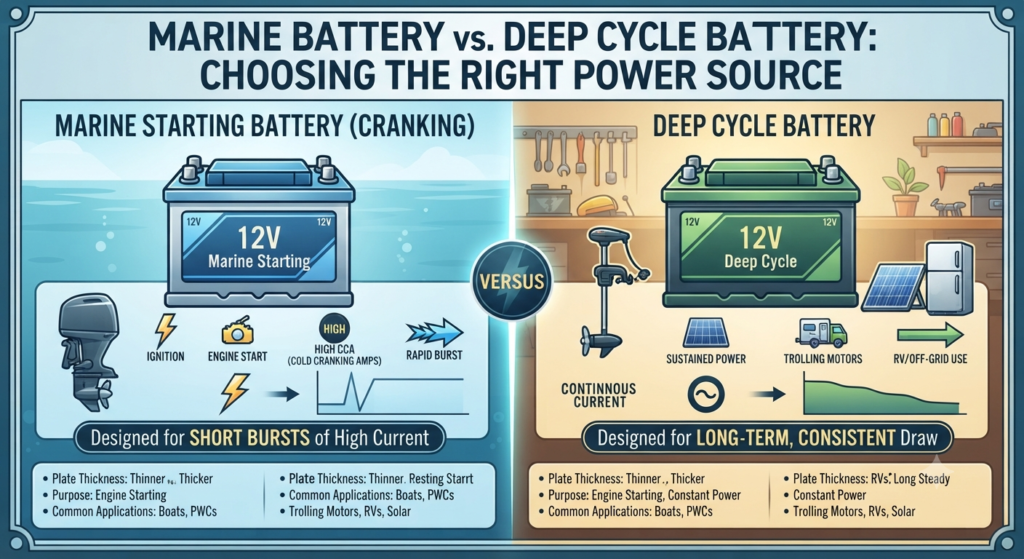
The main difference between Marine Battery vs. Deep Cycle Battery is their design purpose and power-delivery characteristics. A marine battery is designed specifically for boats and other marine applications and may function as a starting, deep-cycle, or dual-purpose battery. A deep cycle battery is designed to provide sustained power through repeated discharge and recharge cycles. Therefore, a marine battery focuses on the demands of the marine environment, while a deep cycle battery focuses primarily on prolonged energy delivery.
Understanding Marine Battery vs. Deep Cycle Battery helps boat owners, anglers, RV users, and off-grid system operators select a battery that matches their power requirements. A starting marine battery can deliver a high current for engine cranking, while a deep cycle battery can supply steady power to trolling motors, lights, electronics, and other loads for longer periods.
Marine Battery vs. Deep Cycle Battery Comparison Table
The table below highlights the major differences between a marine battery and a deep cycle battery.
| Feature | Marine Battery | Deep Cycle Battery |
| Primary Purpose | Starting engines and powering marine equipment | Providing sustained power over longer periods |
| Design | Designed for marine conditions and may combine starting and cycling characteristics | Designed for repeated discharge and recharge |
| Discharge Pattern | Depends on battery type; starting models provide short bursts | Provides relatively steady current for extended periods |
| Cranking Power | Often high, especially in starting models | Usually lower than a dedicated starting battery |
| Deep Discharge | Depends on construction and battery type | Specifically designed for deeper discharge |
| Plate Design | Varies by starting, deep-cycle, or dual-purpose construction | Generally uses construction optimized for cycling |
| Vibration Resistance | Designed to withstand vibration and movement on boats | Depends on battery construction and application |
| Typical Applications | Boats, marine electronics, engine starting, trolling systems | Solar storage, RVs, golf carts, backup systems, trolling motors |
| Environment | Primarily marine environments | Marine and non-marine environments |
| Versatility | High when using a dual-purpose model | High for sustained-energy applications |
| Best For | Marine applications requiring appropriate starting or dual-purpose performance | Loads requiring repeated deep discharge |
| Main Advantage | Designed for the specific demands of boating | Provides reliable energy during extended discharge |
What Is a Marine Battery?
A marine battery is a battery designed for use in boats and other watercraft. It supplies electrical power for engine starting, navigation equipment, lighting, communication systems, trolling motors, and other onboard electrical loads.
The term marine battery does not describe only one battery design. Marine batteries can include starting batteries, deep cycle batteries, and dual-purpose batteries. Each type serves a different purpose.
A marine starting battery provides a high current for a short time to crank an engine. A marine deep cycle battery supplies power for longer periods and can tolerate repeated discharge cycles. A dual-purpose marine battery combines some characteristics of both designs.
Marine batteries also need to operate reliably in conditions involving vibration, movement, moisture, and temperature changes. Therefore, battery selection should consider both the electrical load and the physical conditions of the boat.
Types of Marine Batteries
Marine batteries generally fall into three main categories:
- Marine Starting Battery
- Marine Deep Cycle Battery
- Marine Dual-Purpose Battery
A marine starting battery is suitable when engine starting is the primary requirement. A marine deep cycle battery is better when the battery mainly powers onboard electrical loads. A dual-purpose battery can be useful when one battery must perform both functions.
Marine Starting Battery
A marine starting battery is designed to deliver a high current for a short period. This high-current output allows the battery to crank the boat engine.
Starting batteries generally use a construction that provides a large surface area for rapid current delivery. They are not intended for repeated deep discharges because frequent deep discharge can shorten their service life.
Marine Deep Cycle Battery
A marine deep cycle battery is designed to provide sustained energy for loads such as trolling motors, fish finders, lights, pumps, and other electronics.
It can tolerate deeper discharge than a typical starting battery. This makes it more suitable when a boat requires electrical power for several hours without running the engine continuously.
Marine Dual-Purpose Battery
A marine dual-purpose battery combines starting and cycling characteristics in one battery.
It can provide enough starting power for the engine while also supplying energy to selected onboard electrical loads. This makes it useful when space or battery capacity limits the installation of separate starting and house batteries.
However, a dual-purpose battery represents a compromise. It may not provide the same starting performance as a dedicated starting battery or the same deep-cycle capability as a purpose-built deep cycle battery.
What Is a Deep Cycle Battery?
A deep cycle battery is designed to deliver electrical energy over an extended period and withstand repeated discharge and recharge cycles.
Unlike a starting battery, which delivers a large current for a short time, a deep cycle battery is intended to provide a more sustained output. This characteristic makes it suitable for applications such as solar energy storage, RVs, electric mobility equipment, golf carts, backup systems, and trolling motors.
Deep cycle batteries are available in several chemistries, including:
- Flooded lead-acid
- AGM lead-acid
- Gel lead-acid
- Lithium-ion
- Lithium iron phosphate (LiFePO₄)
The actual discharge capability, charging requirements, cycle life, weight, and maintenance requirements depend on the battery chemistry and manufacturer specifications.
How Does a Deep Cycle Battery Work?
A deep cycle battery stores electrical energy during charging and releases that energy when connected to a load.
Its construction is designed to tolerate repeated discharge and recharge. The battery can therefore supply energy to equipment for an extended period before requiring recharging.
For example, a deep cycle battery used with a trolling motor may gradually discharge while the motor operates. After use, the battery is recharged and prepared for another cycle.
The allowable depth of discharge depends on the battery chemistry and manufacturer. Lead-acid batteries generally benefit from avoiding very deep discharges, while many lithium batteries can safely operate at a greater usable depth of discharge.
Marine Battery vs. Deep Cycle Battery: Key Differences
1. Purpose and Design
The primary difference in Marine Battery vs. Deep Cycle Battery is their intended application.
A marine battery is specifically associated with marine use. It may be designed for engine starting, deep cycling, or both.
A deep cycle battery is defined primarily by its ability to provide sustained energy and withstand repeated discharge cycles. It can operate in marine applications as well as many non-marine applications.
Therefore, marine describes the application environment, while deep cycle describes an important battery design characteristic.
2. Starting Power
Marine starting batteries generally provide strong cranking performance because they must start boat engines.
A deep cycle battery is optimized for sustained energy delivery rather than maximum engine-cranking current. Although some deep cycle batteries can start engines, they may not be the best choice for applications that require frequent high-current starting.
If reliable engine starting is the primary requirement, a dedicated starting battery is usually more appropriate.
3. Deep Discharge Capability
Deep cycle batteries are specifically designed to handle repeated discharge.
Marine batteries may or may not provide the same deep-cycle capability. Therefore, a marine starting battery should not be treated like a deep cycle battery simply because it is designed for marine use.
In contrast, a marine deep cycle battery combines the requirements of the marine environment with the ability to handle repeated deep discharges.
4. Construction
Battery construction varies according to the intended function.
Starting batteries generally use construction that supports high current for short periods. Deep cycle batteries use construction designed to support repeated discharge and recharge.
Marine batteries may also incorporate features intended to tolerate vibration and movement associated with watercraft.
The exact construction depends on the battery chemistry and model, so users should check the manufacturer’s specifications rather than assuming that all marine batteries have the same internal design.
5. Discharge Characteristics
A starting marine battery is designed to provide a large current for a short period.
A deep cycle battery is designed to provide power for a longer period at a relatively steady rate.
For example, starting an engine may require a high current for a few seconds, whereas running a trolling motor or onboard electronics may require continuous power for several hours.
6. Typical Applications
Marine batteries are commonly used for:
- Boat engine starting
- Trolling motors
- Navigation equipment
- Marine lighting
- Fish finders
- Radios
- Pumps
- Onboard electronics
Deep cycle batteries are commonly used for:
- Solar energy storage
- RV electrical systems
- Golf carts
- Electric mobility equipment
- Backup power
- Trolling motors
- Marine house power systems
There is considerable overlap between the two categories. A deep cycle battery can be a marine battery when it is designed and specified for marine use.
7. Environmental Requirements
Marine batteries operate in an environment where vibration, moisture, temperature variation, and movement can affect battery performance.
A marine battery therefore needs to be suitable for the physical conditions of the vessel.
A standard deep cycle battery may provide excellent cycling performance but may not be appropriate for every marine installation. Before installing one on a boat, check whether the battery is approved or designed for the intended marine application.
8. Versatility
A dual-purpose marine battery provides greater versatility when one battery must handle engine starting and moderate electrical loads.
A dedicated deep cycle battery is more specialized for sustained energy delivery.
Therefore, the best option depends on whether the system prioritizes starting power, sustained power, or both.
Are All Marine Batteries Deep Cycle Batteries?
No, not all marine batteries are deep cycle batteries.
The term marine battery describes a battery intended for marine applications. It does not automatically indicate that the battery is designed for deep cycling.
Marine batteries can include:
- Starting batteries
- Deep cycle batteries
- Dual-purpose batteries
A marine starting battery is designed primarily for engine starting. A marine deep cycle battery is designed for sustained electrical loads. A dual-purpose battery attempts to provide both functions.
Therefore, you should always check the battery’s specifications before selecting it for a deep-cycle application.
Can a Deep Cycle Battery Be Used as a Marine Battery?
Yes, a deep cycle battery can be used in a marine application when the battery is suitable for that application and meets the installation requirements.
For example, a properly specified deep cycle battery can power a trolling motor, navigation equipment, lights, pumps, and other onboard electrical loads.
However, not every deep cycle battery is automatically suitable for marine use. The battery must have appropriate protection, mounting, environmental resistance, and charging compatibility for the vessel.
A deep cycle battery may also be unsuitable as the primary engine-starting battery if its cranking capability does not meet the engine manufacturer’s requirements.
When Should You Use a Marine Battery?
You should use a marine battery when the battery will operate on a boat or other marine vessel and must meet the demands of that environment.
A marine starting battery is appropriate when:
- Engine starting is the primary requirement.
- The engine requires high cranking current.
- The battery is used mainly for short starting events.
A marine deep cycle battery is appropriate when:
- The battery powers a trolling motor.
- The boat has significant electrical loads.
- Equipment operates for extended periods.
- The battery undergoes repeated discharge and recharge cycles.
A dual-purpose marine battery can be considered when:
- Space is limited.
- One battery must perform multiple functions.
- The system requires both starting and moderate cycling capability.
When Should You Use a Deep Cycle Battery?
A deep cycle battery is preferable when the main requirement is sustained electrical power rather than short bursts of starting current.
Common applications include:
Solar Energy Systems
Deep cycle batteries can store electrical energy generated by solar panels and provide that energy when solar generation is unavailable.
RVs and Camper Vans
They can power lights, fans, refrigerators, control systems, and other auxiliary loads for extended periods.
Golf Carts
Deep cycle batteries are widely used to provide repeated energy during driving cycles.
Trolling Motors
A deep cycle battery can provide steady energy to an electric trolling motor during fishing trips.
Backup Power
Deep cycle batteries can supply energy to selected loads during a power interruption.
Marine House Systems
A deep cycle marine battery can power onboard equipment when the engine is not running.
Marine Battery vs. Deep Cycle Battery for a Boat
For a boat, the choice between a marine battery and a deep cycle battery depends on what the battery needs to do.
For engine-starting applications, choose an appropriate marine starting battery.
Trolling motors and onboard electrical equipment generally require a marine deep cycle battery that can handle repeated discharge cycles.
When both engine starting and electrical loads must be supported by the same battery, a marine dual-purpose battery can offer a practical solution.
For larger boats, using separate starting and house batteries can provide better performance because each battery can perform the function for which it was designed.
Marine Battery vs. Deep Cycle Battery for Trolling Motor
A deep cycle battery is generally the better choice for a trolling motor because the motor can draw current continuously for an extended period.
Trolling motors require sustained energy rather than a short starting burst. Therefore, the battery should have sufficient capacity and be designed for repeated cycling.
When selecting a trolling motor battery, consider:
- Battery voltage
- Amp-hour capacity
- Motor current requirement
- Expected operating time
- Battery chemistry
- Weight
- Charging requirements
- Available installation space
Lithium batteries can offer lower weight and greater usable capacity than comparable lead-acid batteries, but their higher initial cost and specific charging requirements should also be considered.
Marine Battery vs. Deep Cycle Battery for Starting an Engine
A marine starting battery is generally better suited to engine starting than a conventional deep cycle battery.
Engine starting requires a high current for a short period. Starting batteries are specifically designed for this type of demand.
A deep cycle battery prioritizes sustained energy delivery and repeated cycling. Some modern lithium batteries can provide both deep-cycle operation and high starting current, but users should verify the manufacturer’s starting-current specifications before using one for engine starting.
Marine Battery vs. Deep Cycle Battery: Which One Lasts Longer?
There is no universal answer because battery life depends on chemistry, depth of discharge, charging, temperature, usage pattern, and maintenance.
A properly used deep cycle battery can provide many discharge cycles because its design supports repeated cycling.
A marine starting battery can also provide long service when used mainly for starting and maintained correctly. However, repeatedly discharging a starting battery deeply can shorten its service life.
For this reason, the battery that lasts longest is generally the one that matches the application.
How to Maintain Marine and Deep Cycle Batteries
Proper maintenance can improve battery performance and service life.
Keep the Battery Fully Charged
Avoid leaving lead-acid batteries in a discharged condition for extended periods. Prolonged partial or full discharge can contribute to sulfation and capacity loss.
Clean the Terminals
Inspect battery terminals periodically and clean corrosion when necessary. Good electrical connections reduce resistance and voltage drop.
Use the Correct Charger
Use a charger compatible with the battery chemistry. Lead-acid and lithium batteries have different charging requirements, so a charger designed for one chemistry may not be appropriate for another.
Avoid Excessive Discharge
Follow the manufacturer’s recommended depth-of-discharge limits. Repeatedly discharging a battery beyond its recommended limit can reduce service life.
Check Flooded Lead-Acid Batteries
For serviceable flooded lead-acid batteries, check the electrolyte level according to the manufacturer’s instructions and add distilled water when required.
Do not add water to sealed batteries unless the manufacturer specifically instructs you to do so.
Store Batteries Properly
If the boat or equipment will remain unused for an extended period, follow the manufacturer’s storage recommendations. Disconnect unnecessary loads and maintain the battery at the recommended state of charge.
Factors to Consider Before Choosing a Battery
Before choosing between a marine battery and a deep cycle battery, consider the following factors:
1. Application
Determine whether you need engine starting, sustained power, or both.
2. Battery Capacity
Check the required amp-hour capacity for loads that operate over extended periods.
3. Starting Current
For engine starting, verify that the battery provides sufficient cranking capability.
4. Voltage
Select a battery voltage that matches the electrical system, such as 12 V or 24 V.
5. Battery Chemistry
Compare lead-acid, AGM, gel, and lithium-based options according to cost, weight, maintenance, cycle life, and charging requirements.
6. Available Space
Measure the battery compartment before purchasing. Check dimensions, terminal arrangement, and mounting requirements.
7. Weight
Battery weight can be important in boats, RVs, and other mobile applications. Lithium batteries are generally much lighter than comparable lead-acid batteries.
8. Charging System
Ensure that the alternator, charger, solar controller, or other charging equipment is compatible with the selected battery.
Marine Battery vs. Deep Cycle Battery: Which Is Better?
Neither battery is universally better. The better choice depends on the application.
A marine battery is the better choice when you need a battery specifically designed for marine conditions and the required function is engine starting, deep cycling, or a combination of both.
A deep cycle battery is the better choice when you need sustained energy and repeated discharge and recharge cycles.
For a boat that has separate starting and house electrical systems, using a dedicated starting battery and a dedicated deep cycle battery can provide the best overall performance.
Conclusion
The comparison of Marine Battery vs. Deep Cycle Battery shows that the two terms describe different aspects of battery selection. A marine battery is intended for use in boats and other marine applications and may be designed for starting, deep cycling, or both. A deep cycle battery is designed primarily to provide sustained energy and tolerate repeated discharge and recharge cycles.
A marine starting battery is suitable for delivering the high current needed to start an engine, while a marine deep cycle battery is better suited to trolling motors, lights, pumps, and other onboard loads that operate for longer periods. A dual-purpose marine battery can provide a compromise when both starting and cycling capability are required from one battery.
The key point is that not every marine battery is a deep cycle battery, and not every deep cycle battery is automatically suitable for marine use. Always match the battery to the required starting current, energy capacity, discharge pattern, battery chemistry, charging system, and environmental conditions.
Frequently Asked Questions (FAQs)
The main difference is their intended function. A marine battery is designed for marine applications and may provide starting, deep-cycle, or dual-purpose operation. A deep cycle battery is designed primarily for sustained power and repeated discharge and recharge cycles.
No. Marine batteries can include starting, deep cycle, and dual-purpose designs. Therefore, the term marine battery does not automatically mean deep cycle battery.
Yes, if the battery is suitable for the marine application and meets the vessel’s electrical, mounting, environmental, and charging requirements.
A marine starting battery is generally better for engine starting because it is designed to provide high cranking current for a short period.
Generally, yes. A deep cycle battery is designed to provide sustained power and tolerate repeated discharge, making it well suited to trolling motors.
Read Next:
- How Do You Test a Lead Acid Battery? (Complete Guide)
- Maximising Battery Life: 11 Proven Tips for Long-Lasting Performance
- Difference Between CCA and CA: Key Differences in Battery Ratings
- Battery Sulfation: Causes, Effects, Symptoms, and Prevention
- Deep Cycle Batteries vs. Starting Batteries
- Battery Comparison Chart: Lead-Acid, Lithium-Ion & LFP