Battery ratings describe important characteristics such as voltage, current capability, and capacity. One of the most important ratings is the battery’s capacity, which indicates how much electrical charge the battery can deliver before its stored chemical energy is depleted. A battery produces current through electrochemical reactions that involve the movement of electrons and ions. Because a fully charged battery contains a finite amount of reactive material, it can supply only a limited amount of charge to an external circuit.
Although battery capacity could be expressed as the total number of electrons available, such a number would be extremely large and inconvenient to use. The coulomb provides a more practical unit of electric charge. One coulomb represents approximately electrons.
For batteries, however, capacity is normally specified in ampere-hours (Ah). An ampere represents a current flow of one coulomb per second. Since one hour contains 3,600 seconds, the relationship between coulombs and ampere-hours is:
1 ampere-hour (Ah) = 3,600 coulombs
This unit makes battery capacity much easier to understand and compare. For example, a 10 Ah battery can theoretically deliver 10 A for one hour, 5 A for two hours, or 1 A for approximately ten hours, subject to the battery’s operating conditions and discharge characteristics.
What Are the Types of Battery Ratings?
Battery ratings describe different electrical characteristics that help determine how a battery will perform in an application. Commonly used ratings include voltage, ampere-hour (Ah) capacity, and C-rating. Voltage indicates the battery’s electrical potential, the Ah rating indicates its charge capacity, and the C-rating indicates how quickly the battery can be charged or discharged relative to its rated capacity.
C-Rating
The battery C-rating indicates the charging or discharging current in relation to the battery’s rated capacity. A 1C rate means that the current is equal to the battery’s Ah rating. For example, a 100 Ah battery operating at 1C has a theoretical current of 100 A.
The approximate relationship between C-rating and discharge time is shown below:
| C-Rating | Approximate Time |
| 5C | 12 minutes |
| 2C | 30 minutes |
| 1C | 1 hour |
| 0.5C or C/2 | 2 hours |
| 0.2C or C/5 | 5 hours |
| 0.1C or C/10 | 10 hours |
| 0.05C or C/20 | 20 hours |
The actual charging or discharging time can differ from these theoretical values because of battery chemistry, temperature, charging efficiency, internal resistance, battery age, and operating conditions.
Ah Rating
The Ah rating indicates a battery’s charge capacity and is explained in detail in the following section.
How to Calculate the C-Rating of a Battery?
The battery C-rating shows the charging or discharging current in relation to the battery’s rated capacity. It allows you to determine how quickly a battery can theoretically charge or discharge.
The C-rating can be calculated using the following formula:
For example, consider a battery with a rated capacity of 100 Ah that charges or discharges at 100 A:
Therefore, the battery is operating at a 1C rate. If the same 100 Ah battery operates at 50 A, its C-rating is 0.5C. At 200 A, the C-rating is 2C.
The C-rating can also be used to determine the approximate current corresponding to a particular rate:
For example, a 100 Ah battery operating at 0.5C would supply approximately:
These calculations provide theoretical values. The actual charging or discharging performance depends on the battery chemistry, temperature, state of charge, internal resistance, battery age, and the manufacturer’s specified limits.
Amp-Hour Application to Measure the Battery’s Capacity
The amp-hour (Ah) rating gives an approximate indication of how long a battery can supply a particular current. For example, a 1 Ah battery could ideally deliver 1 A for 1 hour, 2 A for 30 minutes, or 0.5 A for 2 hours. The basic relationship is:
However, real batteries do not maintain this simple relationship at every discharge rate. Battery capacity depends on factors such as discharge current, temperature, battery chemistry, age, and operating conditions. Manufacturers therefore specify battery capacity at a particular discharge current and test duration.
For example, a 70 Ah automotive battery rated at 3.5 A has a theoretical discharge time of:
If the load increases to 70 A, the theoretical calculation gives only 1 hour. In practice, the battery may discharge sooner because the higher current increases internal losses and heat generation, reducing the usable capacity.
Similarly, a very small load does not necessarily allow the battery to operate for the extremely long period predicted by the Ah calculation. Self-discharge, internal leakage, electrolyte changes, and electrode deterioration can gradually reduce the available capacity.
Therefore, the amp-hour rating should be used as an approximate measure of battery capacity, rather than as an exact prediction of operating time. For an accurate estimate, the battery’s specified discharge current, temperature, and manufacturer’s derating information should be considered.
For rechargeable batteries, the Ah rating can also provide a rough indication of charging time. A 70 Ah battery charged at a constant 7 A would theoretically require about:
Actual charging normally takes longer because charging efficiency is less than 100% and the charging current typically decreases as the battery approaches full charge.
Examples of Battery Capacity Ratings
- Automotive battery: 70 Ah at 3.5 A — secondary battery
- D-size carbon-zinc battery: 4.5 Ah at 100 mA — primary battery
- 9 volt carbon-zinc battery: 400 milliamp-hours @ 8 mA (primary cell)
Calculating Battery Capacity in Ampere-Hours
The battery’s Ah rating can be calculated when the discharge current and operating time are known:
For example, if a battery supplies 30 A for 0.5 hours, its theoretical capacity is:
In practical applications, the measured capacity may differ from this calculated value because battery capacity depends on the discharge rate and operating conditions. Therefore, the manufacturer’s rated capacity and test conditions should always be considered when evaluating a battery.
How to Check the Condition of the Battery – With and Without Load
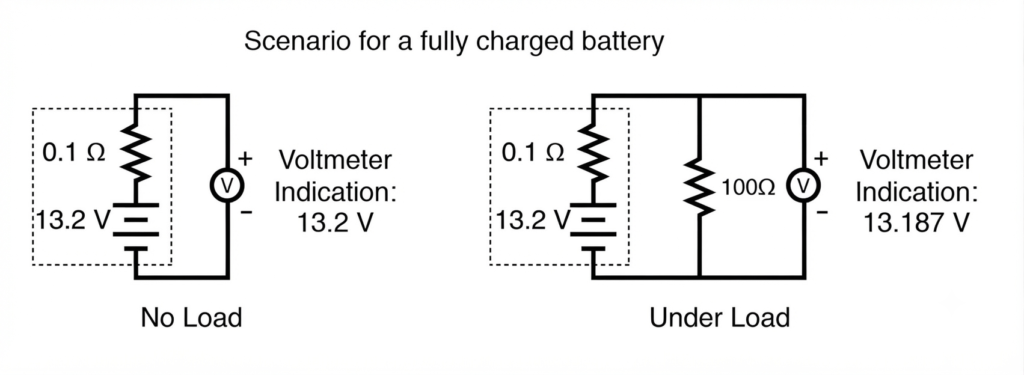
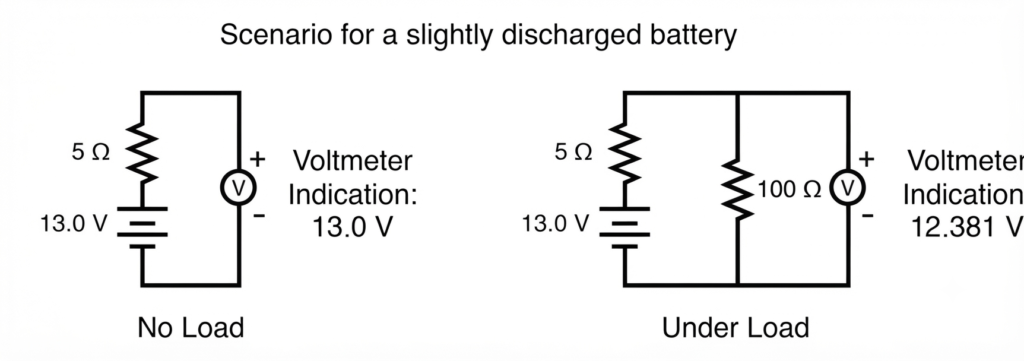
A battery’s condition can be checked by measuring its terminal voltage both without a load and under load. As a battery discharges, its available chemical energy decreases, its internal resistance generally increases, and its open-circuit voltage falls. The increase in internal resistance is particularly important because a battery may still show a normal voltage when measured with no load while being unable to deliver sufficient current to a circuit.
Checking a Battery Without Load
A simple way to check a battery is to measure its open-circuit voltage (OCV) with a voltmeter. Connect the meter across the positive and negative terminals without connecting a significant load.
A reasonably high terminal voltage can indicate that the battery has charge remaining, but this test alone does not always confirm that the battery is in good condition. A battery with increased internal resistance may show an apparently normal voltage without a load but experience a significant voltage drop as soon as current flows.
Checking a Battery Under Load
A load test provides a better indication of the battery’s ability to deliver current. When a load draws substantial current, the voltage drop caused by the battery’s internal resistance becomes more noticeable.
The terminal voltage can be represented approximately by:
where:
- Vterminal = voltage measured while the battery is supplying current
- VOC = open-circuit voltage
- I = load current
- Rinternal = internal resistance of the battery
If the voltage falls sharply when the load is connected, the battery may have high internal resistance or insufficient capacity to supply the required current. The appropriate test current depends on the battery type and its manufacturer’s specifications.
Therefore, measuring voltage only with a voltmeter may not provide a complete assessment of battery condition. Comparing the open-circuit voltage with the voltage under a suitable load gives a much better indication of the battery’s ability to deliver usef
Fully Charged Battery:
Slightly Discharged Battery:
Now, if the battery discharges to some extent, its terminal voltage gradually decreases and its internal resistance increases. As a result, the battery may still show a reasonable voltage when measured without a load, but its voltage can drop significantly when it supplies current to a load. This voltage drop provides a useful indication of the battery’s remaining condition and its ability to deliver current.
Dead Battery:
As the battery discharges further and further toward complete depletion, its terminal voltage continues to fall while its internal resistance increases. Eventually, the battery can no longer deliver the required current effectively and reaches the end of its useful discharge.
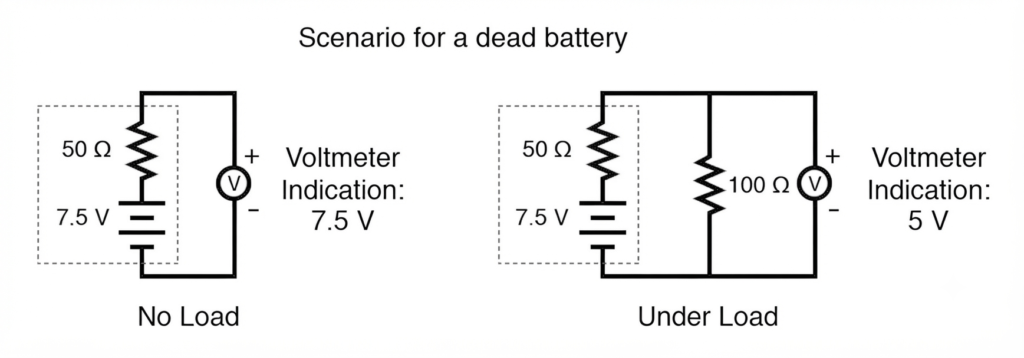
A load test provides a much clearer indication of a battery’s actual condition than a voltage measurement taken with no load. However, this does not make a simple voltmeter test useless. If a battery that should have a nominal voltage of around 13.2 V measures only 7.5 V across its terminals, the battery is clearly severely discharged or faulty. On the other hand, a reading of 12.5 V does not tell you conclusively whether the battery is fully charged or partially discharged. In such a case, a load test is needed to determine how well the battery can deliver current.
When performing a load test, the test resistance must be capable of safely handling the power produced by the battery. This requirement becomes particularly important when testing high-capacity batteries, such as a 12 V automotive lead-acid battery, because the test load may need to dissipate several hundred watts.
Conclusion
Understanding battery ratings is essential for selecting and evaluating a battery for a specific application. Voltage indicates the electrical potential of the battery, while current capability shows how much current it can deliver. The ampere-hour (Ah) rating indicates the battery’s capacity and provides an approximate idea of how long it can supply a particular current under specified conditions.
However, the rated capacity does not guarantee the same performance in every situation. Discharge current, temperature, battery age, internal resistance, and operating conditions can all affect actual performance. As a battery discharges or deteriorates, its internal resistance generally increases, which can cause a greater voltage drop when the battery supplies a load.
Therefore, battery ratings should be considered together with the manufacturer’s specifications and the actual operating conditions. Checking both open-circuit voltage and voltage under an appropriate load provides a better understanding of the battery’s condition and its ability to deliver the required power reliably.
Read Next:
- How Do You Test a Lead Acid Battery? (Complete Guide)
- Maximising Battery Life: 11 Proven Tips for Long-Lasting Performance
- Difference Between CCA and CA: Key Differences in Battery Ratings
- Battery Sulfation: Causes, Effects, Symptoms, and Prevention
- Deep Cycle Batteries vs. Starting Batteries
- Battery Comparison Chart: Lead-Acid, Lithium-Ion & LFP
- How to Change a Car Battery: 12 Steps Explained
- Marine Battery vs. Deep Cycle Battery: Key Differences, Uses