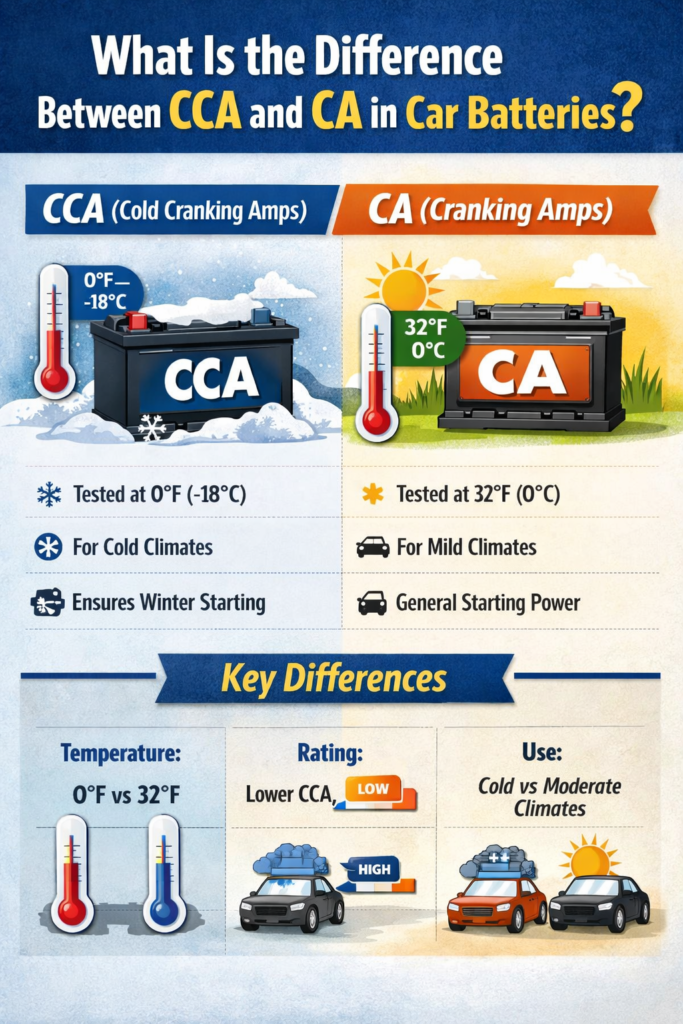
The difference between CCA and CA is an important concept when choosing the right car battery. Both CCA (Cold Cranking Amps) and CA (Cranking Amps) measure a battery’s ability to start an engine, but they are tested under different temperature conditions. Understanding how these ratings work helps vehicle owners select a battery that performs reliably in different climates.
In simple terms, CCA measures starting power in extremely cold temperatures, while CA measures starting power in moderate temperatures. Because temperature affects battery performance, these ratings give insight into how well a battery will function under specific environmental conditions.
Understanding CCA and CA Ratings
Car batteries must deliver a strong burst of electrical current to start an engine. This power output is measured using ratings such as Cold Cranking Amps (CCA) and Cranking Amps (CA). Both ratings represent the amount of current a battery can provide for a short time while maintaining a minimum voltage level.
However, the main difference lies in the temperature at which the test is performed. Since batteries produce less power in cold conditions, ratings measured at lower temperatures are more demanding.
CCA Rating: Definition and Importance
Cold Cranking Amps (CCA) measures the number of amps a battery can deliver for 30 seconds at 0°F (-18°C) while maintaining at least 7.2 volts for a 12-volt battery.
This rating is especially important in cold climates because engines require more power to start when temperatures drop. Thick engine oil and increased internal resistance make it harder for the engine to turn over. A battery with a higher CCA rating ensures reliable starts even in freezing conditions.
Why CCA Matters
- Ensures the engine starts in cold weather
- Indicates battery strength in harsh environments
- Higher ratings provide better reliability in winter conditions
CA Rating: What Does It Mean?
Cranking Amps (CA) measures the amount of current a battery can supply for 30 seconds at 32°F (0°C) while maintaining a minimum voltage of 7.2 volts.
Because the test is performed at a warmer temperature than the CCA test, the CA rating is usually higher than the CCA rating for the same battery. This rating reflects battery performance in normal or moderate climate conditions.
Why CA Rating Is Useful
- Indicates starting power in average temperatures
- Provides a realistic measure for moderate climates
- Helps compare battery performance for everyday conditions
Key Difference Between CCA and CA
The primary difference between CCA and CA lies in the temperature at which the battery’s performance is measured.
| Parameter | CCA (Cold Cranking Amps) | CA (Cranking Amps) |
| Meaning | Measures battery starting power in cold temperatures | Measures battery starting power in moderate temperatures |
| Test Temperature | 0°F (-18°C) | 32°F (0°C) |
| Current Delivery Time | 30 seconds while maintaining at least 7.2 volts | 30 seconds while maintaining at least 7.2 volts |
| Rating Value | Usually lower due to extreme cold testing conditions | Usually higher because the test is done at warmer temperatures |
| Best For | Vehicles operating in cold or freezing climates | Vehicles used in moderate or warm climates |
| Importance | Ensures reliable engine starting during winter | Indicates general starting performance in normal weather |
| Common Use | Cars and trucks in cold regions | Cars and boats in mild environments |
Because batteries perform better in warmer temperatures, the CA value is usually higher than the CCA value.
Why CCA Matters More in Cold Climates
In freezing temperatures, a battery’s chemical reactions slow down, reducing its ability to deliver power. At the same time, the engine requires more current to start due to thicker oil and increased mechanical resistance.
This is why CCA ratings are critical in cold regions. A battery with insufficient CCA may struggle to start the engine during winter, even if it works fine in warmer weather.
When to Consider CA Rating for Your Car Battery
The CA rating becomes more relevant in areas with mild or moderate climates where extreme cold is rare. Since the test temperature is closer to typical weather conditions, it gives a realistic measure of starting power in everyday situations.
You should pay attention to the CA rating if:
- You live in a warm or moderate climate
- Your vehicle rarely experiences freezing temperatures
- You want to compare general battery starting performance
How to Read Battery Labels: CCA vs. CA
Most automotive batteries display both CCA and CA ratings on the label. Understanding these numbers can help you choose the right battery.
For example:
- CCA 600 – Battery can deliver 600 amps at 0°F for 30 seconds.
- CA 750 – Battery can deliver 750 amps at 32°F for 30 seconds.
Since the CA test is performed at a warmer temperature, the CA value is typically 20–25% higher than the CCA rating.
Impact of CCA and CA Ratings on Battery Performance
Both ratings influence how well a battery performs during engine ignition. A battery with higher ratings generally offers stronger starting power and better reliability.
However, choosing the right rating depends on climate and vehicle requirements. Vehicles in cold environments need higher CCA values, while vehicles in warmer regions may rely more on CA ratings.
Choosing the Right Battery: CCA or CA?
Selecting the right battery depends largely on temperature conditions and vehicle needs.
- Cold climates: Choose a battery with a high CCA rating to ensure reliable starts.
- Moderate climates: CA rating can provide a good indication of starting power.
- Manufacturer recommendations: Always follow the battery specifications recommended by the vehicle manufacturer.
A battery with a CCA rating equal to or higher than the original battery is generally recommended for safe and reliable performance.
Common Myths About CCA and CA Ratings
There are several misconceptions about these battery ratings.
Myth 1: CA rating is more important than CCA.
In reality, CCA is more important in cold climates because it measures performance under harsher conditions.
Myth 2: Higher CA automatically means better cold performance.
This is incorrect because CA is measured at a warmer temperature and does not reflect extreme cold performance.
Myth 3: Battery capacity (Ah) determines starting power.
Ampere-hour capacity indicates storage, while CCA measures starting power, which is more important for engine ignition.
Conclusion
The difference between CCA and CA mainly comes down to temperature conditions used in testing battery performance. CCA measures starting power at 0°F, making it crucial for cold climates, while CA measures performance at 32°F, reflecting battery strength in milder conditions.
Understanding these ratings helps drivers select a battery that ensures reliable engine starts, better performance, and longer battery life. When buying a battery, always consider your climate, vehicle requirements, and manufacturer recommendations to make the best choice.
Read Next: