Maintaining battery health is crucial for the performance and longevity of devices ranging from vehicles to backup power systems. One of the most common threats to lead-acid batteries is battery sulfation—a condition that can silently degrade your battery if left unchecked. Understanding its causes, effects, and preventive measures is essential for avoiding costly replacements.
What is Battery Sulfation?
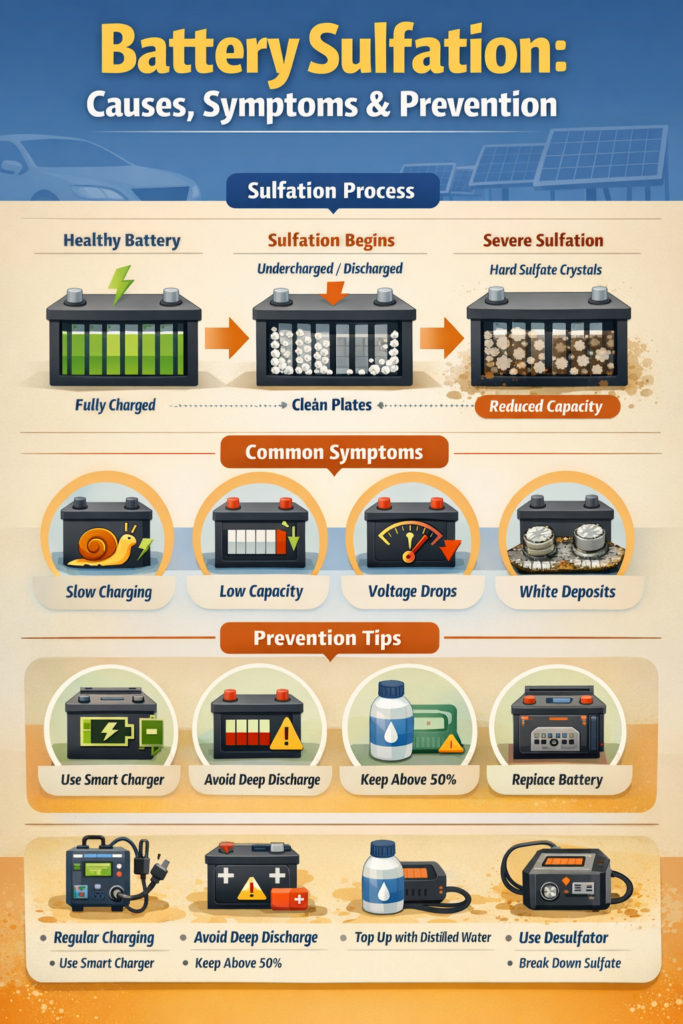
Battery sulfation occurs when lead sulfate crystals form on the battery’s plates. This happens when a lead-acid battery is undercharged, left discharged for extended periods, or exposed to high temperatures. Over time, these crystals harden and reduce the battery’s ability to hold a charge.
Key Data:
- Research shows that 30–50% of premature lead-acid battery failures are due to sulfation.
- Deep discharge cycles accelerate the growth of lead sulfate crystals, making recovery more difficult.
Causes of Battery Sulfation
Several factors contribute to battery sulfation:
- Undercharging: Regular low-voltage operation prevents full conversion of lead sulfate back to active material.
- Long Periods of Disuse: Batteries left discharged in seasonal or backup applications are at high risk.
- High Temperatures: Temperatures above 30°C (86°F) speed up crystal formation.
- Over-Discharge: Repeated deep discharge increases irreversible sulfation.
- Low Electrolyte Levels: Insufficient electrolyte exposes plates to air, worsening sulfation.
Effects of Battery Sulfation
Sulfation impacts battery performance in multiple ways:
- Reduced Capacity: Batteries can lose 20–50% of their original capacity.
- Longer Charging Times: Sulfate crystals slow chemical reactions.
- Voltage Drops: Inconsistent voltage during load operations.
- Complete Failure: Severe sulfation can render a battery unusable.
- Quick discharging – loses stored energy faster
Real-World Example:
Fleet operators often report premature UPS battery failures due to sulfation during long standby periods.
Symptoms of Battery Sulfation
Recognizing sulfation early helps prevent permanent damage:
- Slow or incomplete charging
- Reduced runtime during normal use
- White or grayish deposits on terminals or battery plates
- Frequent voltage drops under load
Prevention and Corrective Measures
Proactive maintenance is the key to preventing sulfation. The table below summarizes indicators, prevention tips, and corrective actions for quick reference:
| Sulfation Indicator | Cause / Risk Factor | Prevention Tips | Corrective Actions |
| Slow charging | Undercharging or infrequent charging | Use smart chargers; maintain proper voltage cycles | Apply a pulse desulfator or controlled equalization charge |
| Reduced battery runtime | Deep discharge or prolonged low charge | Avoid discharging below recommended levels | Recondition battery using desulfation methods |
| Voltage drops under load | Lead sulfate buildup on plates | Regular maintenance, monitor battery voltage | Perform controlled charging cycles to dissolve sulfate crystals |
| White or gray deposits on terminals/plates | Electrolyte evaporation or exposure | Check and top up electrolyte levels with distilled water | Clean terminals; use desulfator if internal plates are affected |
| Premature battery failure | Long storage without charge or high temperature | Store in cool, ventilated area; maintain charge | Replace battery if sulfation is severe and irrecoverable |
Data Insights:
- Early detection and preventive maintenance can recover up to 80% of lost battery capacity.
- Combining smart charging with periodic checks reduces sulfation risk by 30–50%.
Types of Sulfation in Batteries
Sulfation in batteries generally occurs in two main forms:
1. Soft Sulfation
This is the initial stage of sulfation, where the sulfate crystals that form on the battery plates are still small and loosely attached. At this stage, the condition is usually reversible. Applying a sulfate charge or using a charger with a desulfation mode can often break down these crystals and restore the battery’s performance.
2. Hard Sulfation
This is a more severe and advanced stage. Over time, the sulfate crystals grow larger and become firmly attached to the battery plates. Once sulfation reaches this stage, it becomes very difficult—and sometimes impossible—to remove. In many cases, the battery may need to be replaced.
Reversible and Irreversible Battery Sulfation
Battery sulfation does not always lead to permanent damage. It generally occurs in two stages: reversible and irreversible sulfation.
1. Reversible Sulfation
In the early phase, sulfation can often be corrected. A carefully controlled overcharge—typically around 200 mA of regulated current—may help break down and dissolve the sulfate crystals that form on the battery plates. During this recovery process, the voltage can rise to approximately 2.50–2.66 volts per cell (around 15–16 volts for a 12-volt battery) and may be maintained for as long as 24 hours. Increasing the battery temperature to about 50–60°C (122–140°F) during this process can further improve the chances of restoring the battery.
2. Irreversible (Hard) Sulfation
When sulfation is left untreated for a long time, the sulfate crystals grow larger and become solid and stable. At this stage, they cannot be broken down easily. This condition permanently reduces the battery’s capacity, and in most cases the only practical solution is to replace the battery.
Anti-Sulfation Devices
Certain electronic devices are designed to slow down or reduce sulfation by sending electrical pulses through the battery terminals. These devices may help maintain battery health and delay sulfation, but they have limitations:
- They cannot completely repair batteries affected by severe or hardened sulfation.
- Their effectiveness varies, so they should not be relied on as a guaranteed solution.
Conclusion
Battery sulfation is a silent but serious threat to lead-acid batteries. Understanding its causes, recognizing early symptoms, and taking preventive measures can dramatically extend battery life. Regular charging, proper storage, and timely maintenance are the most effective ways to combat sulfation.
Investing in these practices not only saves money but ensures reliable performance for your vehicles, solar systems, and backup power devices.
Read Next: