Testing a lead acid battery is essential to ensure it is performing efficiently and safely. Whether you’re dealing with a car battery, inverter battery, or backup power system, knowing how do you test a lead acid battery can help you avoid unexpected failures and extend battery life.
In this guide, we’ll walk you through different methods of battery checking, explain battery tester results, and help you understand how to check if a battery is good.
Why Battery Testing Is Important
A lead acid battery naturally degrades over time. Regular battery checking helps you:
- Detect weak or failing batteries early
- Improve performance and reliability
- Avoid sudden breakdowns
- Extend battery lifespan
If you’ve ever wondered how to test battery health accurately, the following methods will help.
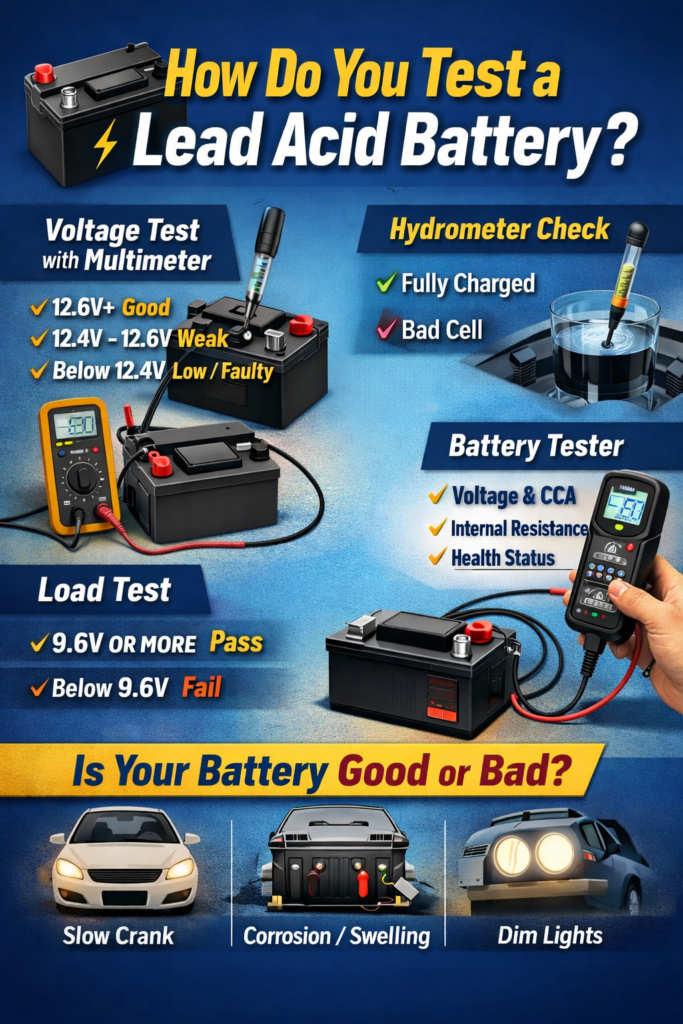
How to test a lead-acid battery
1. Visual Inspection (Basic Battery Checking)
Before using any tools, start with a simple inspection:
- Look for cracks or leaks
- Check for corrosion on terminals
- Ensure electrolyte levels are adequate (for non-sealed batteries)
This basic check battery step can quickly reveal obvious issues.
2. Voltage Test Using a Multimeter
One of the easiest ways to learn how to test battery condition is with a multimeter.
Steps:
- Set the multimeter to DC voltage
- Connect red probe to positive terminal
- Connect black probe to negative terminal
- Read the voltage
To properly interpret it, you need to know the normal voltage range of a lead acid battery. A healthy, fully charged battery typically sits between 12.6V and 12.8V at rest. Here’s how to read your results:
- 12.6V or higher → Fully charged and in good condition
- 12.4V – 12.6V → Moderately charged
- Below 12.4V → Needs charging
- Below 12V → Likely faulty or deeply discharged
Ideally, a battery should remain above 12.5V to stay in good health. At around 12.0V, it is considered fully discharged.
What Can You Learn from This?
- A reading of 12.7V means the battery is healthy and ready to use
- If it drops to 12.5V or lower, recharge it before testing again
- After charging, a good battery should hold above 12.5V
- If it repeatedly falls below that level, it’s a sign the battery is weakening with age
While this method is excellent for quick battery checking, it only shows the resting condition. It doesn’t reflect how the battery performs in real situations.
For a complete evaluation, you also need to test the battery under load—such as during engine start. This type of load testing lead acid batteries reveals how much the voltage drops under stress and gives a more accurate picture of overall battery health.
3. Hydrometer Test (For Flooded Batteries)
A hydrometer is another effective tool for battery checking, especially for flooded lead acid battery types. It measures the specific gravity of the electrolyte, which directly indicates the state of charge inside each cell.
Steps:
- Remove the battery caps carefully
- Draw electrolyte into the hydrometer
- Note the reading for each cell
- Compare the values across all cells
What It Shows:
- 1.265 – 1.300 → Fully charged
- 1.225 – 1.260 → Partially charged
- Below 1.200 → Discharged or weak
- Large variation between cells → Possible damaged cell
Why It Matters
Unlike a simple voltage test, this method helps you look inside the battery and identify issues at the cell level. It’s especially useful for determining how to check if a battery is good because:
- It reveals imbalances between cells
- It detects sulfation or internal damage
- It provides a more accurate state of charge
This method is useful for determining how to check if a battery is good internally.
4. Load Testing Lead Acid Batteries
The most reliable way to evaluate real performance is load testing lead acid batteries. Unlike simple voltage checks, this method shows how the battery behaves under actual working conditions.
How It Works:
- A load tester applies a controlled load similar to real usage (like starting an engine)
- The battery’s voltage drop is measured during the test
Lead Acid Battery Load Test Results:
- Voltage stays above 9.6V → Battery is in good condition
- Voltage drops quickly or below 9.6V → Battery is weak or failing
Why It’s Important
A lead acid battery load test gives a much clearer picture of battery health because it simulates real demand. Even if a battery shows a good resting voltage, it may still fail under load.
This method is considered the most accurate way to determine how to check if a battery is good, as it reveals:
- True power delivery
- Internal resistance issues
- Overall reliability under stress
For complete battery checking, combining load testing with voltage and hydrometer tests ensures you get the most accurate assessment of your lead acid battery.
5. Using a Battery Tester
Modern digital tools have made battery checking faster and more precise. Using a dedicated tester is one of the easiest ways to understand how to test battery performance without complex steps.
What Battery Tester Results Show:
- Voltage → Current charge level
- Internal resistance → Indicates aging or internal damage
- Cold Cranking Amps (CCA) → Starting power capability
- Overall battery health → Pass, recharge, or replace status
Why It’s Useful
Understanding battery tester results helps you make informed decisions about your lead acid battery. Instead of guessing, you get clear data on whether the battery is still usable or nearing the end of its life.
A battery tester combines multiple checks into one process, making it a reliable option for both beginners and professionals. It’s especially helpful when you want a quick and accurate answer to how to check if a battery is good without performing multiple manual tests.
Signs Your Battery Is Failing
If you’re unsure how to check if a battery is good, there are several warning signs that indicate your lead acid battery may be weakening or close to failure. Recognizing these early can help you avoid sudden breakdowns and costly replacements.
1. Slow Engine Crank
One of the most common signs of a failing battery is a slow or sluggish engine start. When you turn the key, the engine may take longer than usual to crank.
What it means:
- The battery is losing its ability to deliver sufficient power
- Cold cranking amps (CCA) may be dropping
- Internal wear is increasing
2. Dim or Flickering Lights
If your headlights, dashboard lights, or interior lights appear dim—especially when starting the vehicle—it’s a sign of weak battery output.
What it means:
- Voltage supply is unstable
- Battery cannot maintain consistent power
- Electrical performance is declining
3. Frequent Need for Charging
If you find yourself charging the battery more often than usual, it’s a clear red flag.
What it means:
- The battery is not holding charge properly
- Possible sulfation or aging
- Reduced capacity over time
A healthy lead acid battery should retain charge for a reasonable period without frequent recharging.
4. Swollen or Bulging Battery Case
A visibly swollen or deformed battery case is a serious warning sign.
What it means:
- Overcharging or excessive heat
- Internal chemical damage
- Risk of leakage or failure
In such cases, immediate replacement is recommended for safety.
5. Low Voltage Readings
Consistently low voltage during battery checking is another clear indicator.
What it means:
- Below 12.4V → Battery needs charging
- Below 12V → Battery may be faulty
- Unable to hold 12.5V+ after charging → Battery is deteriorating
6. Corroded Terminals
White or bluish deposits around the battery terminals can interfere with performance.
What it means:
- Poor electrical connection
- Reduced charging efficiency
- Potential starting issues
Cleaning the terminals may help, but repeated corrosion can signal deeper problems.
7. Battery Fails Load Test
If the battery cannot maintain voltage during a lead acid battery load test, it’s no longer reliable.
What it means:
- Voltage drops below safe levels under load
- Internal resistance is high
- Battery cannot support real-world usage
Tips for Accurate Battery Testing
- Always test when the battery is fully charged
- Avoid testing immediately after charging (let it rest)
- Clean terminals before testing
- Use proper safety gear
Consistent battery checking ensures accurate results.
Conclusion
Understanding how do you test a lead acid battery is essential for maintaining reliability and performance. From simple voltage checks to advanced load testing lead acid batteries, each method plays a role in diagnosing battery health.
Whether you’re performing a quick check battery test or analyzing detailed battery tester results, regular testing will help you determine how to check if a battery is good and prevent unexpected failures.
By following these methods, you can confidently handle any lead acid battery and keep your systems running smoothly.
Read Next:
- Maximising Battery Life: 11 Proven Tips for Long-Lasting Performance
- Difference Between CCA and CA: Key Differences in Battery Ratings
- Battery Sulfation: Causes, Effects, Symptoms, and Prevention
- Deep Cycle Batteries vs. Starting Batteries: Key Differences Guide
- What is a Battery – A Complete Guide to Battery Basics